
Fall Prevention for Elderly at Home: A Room-by-Room Safety Guide for Indian Families
Karnataka Nursing Council Reg. No. 312786
BSc Nursing · 5+ years Apollo Hospital ICU · BLS/CPR Certified
Medically reviewed by Sumit Kumar, RN
In India, one in three adults over 65 years falls at least once a year. Falls are the leading cause of injury-related death and hospitalisation among senior citizens, with hip fractures being the most devastating – carrying a 20–30% mortality rate within one year in elderly patients.
The tragic reality is that most falls are preventable. With the right home modifications, exercises, medication review, and professional nursing support, families can dramatically reduce their elderly loved one's fall risk.
At NurseNest Plus Bangalore, fall prevention is a cornerstone of our elderly care programme. Our nurses are trained to identify risk factors, implement safety measures, and provide the supervision that prevents falls before they happen.
Why Do Elderly People Fall? Understanding Risk Factors
Physical Factors
- Muscle weakness – Legs that can't support body weight during standing or walking
- Balance problems – Inner ear changes, neuropathy, or vision problems affecting stability
- Joint stiffness – Arthritis limiting range of motion, especially in knees and hips
- Vision decline – Cataracts, glaucoma, or macular degeneration reducing depth perception
- Foot problems – Bunions, corns, or neuropathy causing unsteady gait
Medical Factors
- Postural hypotension – Blood pressure drop when standing up (especially common in patients on BP medication)
- Medications – Sleeping pills, anti-anxiety drugs, antidepressants, and diuretics increase fall risk
- Diabetes complications – Peripheral neuropathy causes numbness in feet, reducing awareness of ground surface
- Vitamin D deficiency – Extremely common in Indian seniors; causes muscle weakness and bone fragility
- Urinary urgency – Rushing to the bathroom, especially at night, is a major fall trigger
Environmental Factors (Most Preventable!)
- Wet or slippery floors – especially dangerous during monsoon
- Loose rugs, mats, and electrical cords
- Poor lighting, especially in hallways and stairs
- Cluttered walkways and furniture placement
- High beds without step stools
- Bathrooms without grab bars or anti-slip mats
Room-by-Room Home Safety Modifications
🛏️ Bedroom
- Bed height – When sitting on the bed, the senior's feet should touch the floor flat. Adjust with a platform or use a lower bed
- Bed rails – Install on the side the patient gets up from; prevents rolling out of bed during sleep
- Nightlight – Motion-activated LED nightlight between bed and bathroom
- Phone/call bell – Within arm's reach of the bed
- Remove floor clutter – No loose wires, small rugs, or items on the floor between bed and door
- Firm mattress – A sagging mattress makes getting up difficult
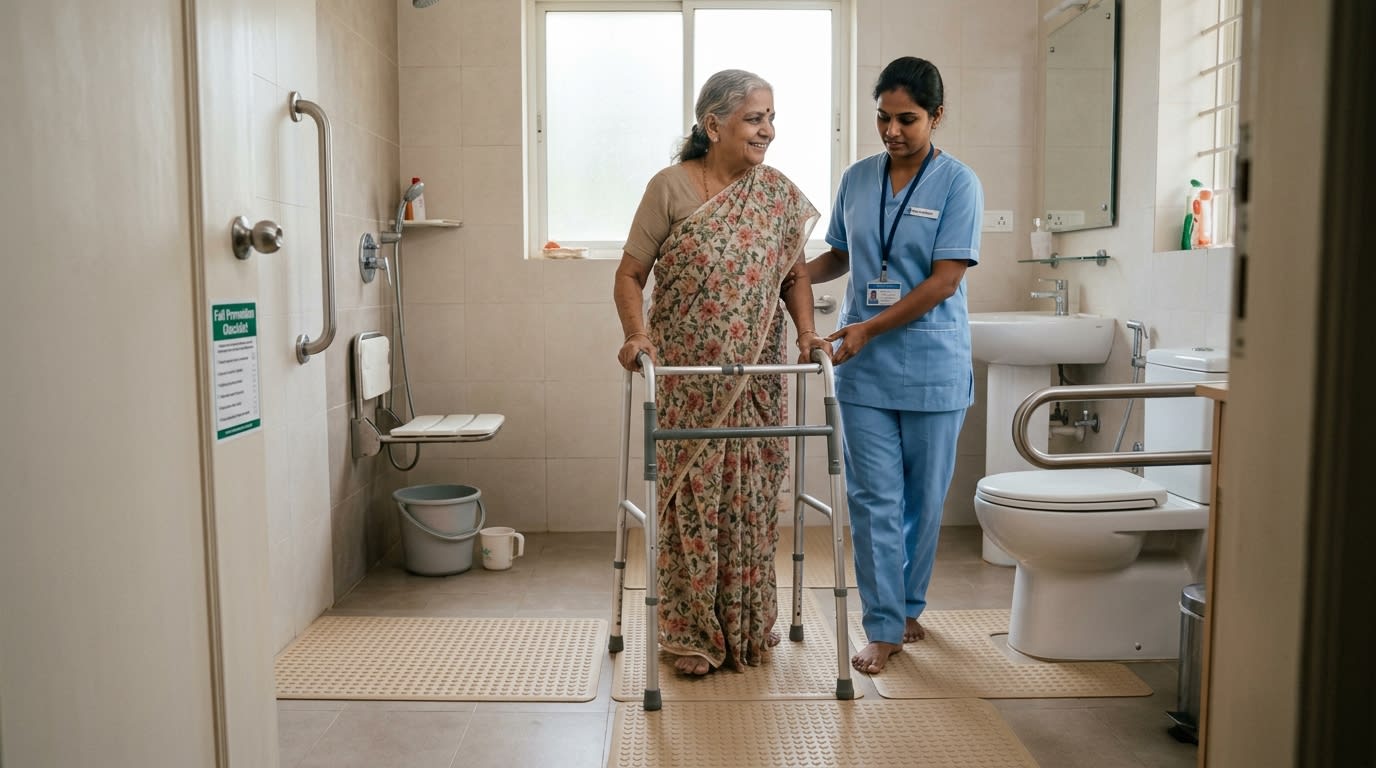
🚿 Bathroom (Most Dangerous Room)
60% of elderly falls happen in the bathroom:
- Grab bars – Install near the toilet (on wall beside and in front) and inside the shower area (stainless steel, rated for 120kg+)
- Anti-slip mats – Inside the shower/bathing area AND outside on the bathroom floor
- Raised toilet seat – Reduces the effort needed to sit down and stand up (available for ₹1,500–₹4,000)
- Shower chair/stool – Allows bathing while seated; eliminates standing-while-wet risk
- Handheld showerhead – No need to reach up or twist; can bathe while seated
- Good drainage – Fix any slow drains that leave water standing on the floor
- Bright lighting – At least 100W equivalent LED; illuminated switch outside the door
- Remove locks – Replace with occupied/vacant indicators; locked bathroom prevents rescue during falls
🏠 Living Room and Hallways
- Clear walking paths – Minimum 3-foot-wide clear path between all frequently used areas
- Remove loose rugs – Or secure them with double-sided tape or non-slip backing
- Secure electrical cords – Route along walls, never across walkways
- Furniture with armrests – Chairs and sofas with firm armrests help with sitting and standing
- Adequate lighting – Eliminate dark corners; install nightlights in hallways
- Pet safety – Be mindful of pets underfoot; use pet gates if needed
🍳 Kitchen
- Frequently used items at waist height – No reaching up to high shelves or bending to low cabinets
- Anti-slip mat near the sink and cooking area
- Sturdy step stool with handrail if higher shelves must be accessed
- Clean spills immediately – Oil and water spills are extremely dangerous
- Well-lit cooking area – Under-cabinet lighting for the counter
🪜 Stairs (If Applicable)
- Handrails on both sides – Continuous, extending beyond the top and bottom steps
- Anti-slip strips on each step edge
- Even lighting – Top and bottom of stairs, with switches at both ends
- No loose carpeting on stairs
- Consider relocating the senior's bedroom to the ground floor if possible
Fall Prevention Exercises (Daily Programme)
Always perform with a nurse or caregiver nearby. Hold onto a sturdy chair or wall for support.
Balance Exercises (5 minutes)
- Single leg stand – Hold chair back, lift one foot, hold 10–30 seconds. Repeat 3 times each leg
- Heel-to-toe walking – Walk in a straight line placing heel directly in front of toes. 10 steps forward and back
- Side leg raises – Hold chair, lift leg sideways, hold 3 seconds. 10 times each leg
Strengthening Exercises (10 minutes)
- Chair squats – Slowly sit into chair, then stand back up. 10 repetitions, 2 sets
- Calf raises – Hold chair back, rise onto toes, hold 3 seconds, lower slowly. 15 repetitions
- Wall push-ups – Stand arm's length from wall, do push-ups against wall. 10 repetitions
- Seated knee extensions – Straighten one leg, hold 5 seconds. 10 each leg
Flexibility (5 minutes)
- Ankle rotations – 10 circles each direction, each foot
- Seated hamstring stretch – extend leg, reach toward toes, hold 15 seconds
- Shoulder and neck gentle stretches
The Monsoon Factor: Extra Fall Risks During Rainy Season
- Wet floors – Rain tracked indoors creates slippery surfaces; mop frequently
- Damp bathrooms – Higher humidity means bathroom floors stay wet longer
- Reduced outdoor activity – Less walking leads to muscle deconditioning, increasing fall risk
- Power cuts – Sudden darkness is a major fall trigger; keep flashlights accessible
- Arthritis flares – Cold, damp weather worsens joint pain and stiffness, reducing mobility
NurseNest Plus Fall Prevention Programme
Our comprehensive approach includes:
- Home safety assessment – Complete room-by-room evaluation with modification recommendations
- 24/7 mobility supervision – Especially during bathroom visits and nighttime movement
- Daily exercise support – Guided balance and strengthening exercises per physiotherapist's plan
- Medication review coordination – Identifying drugs that increase fall risk; coordinating with doctors for alternatives
- Assistive device support – Helping with walker, wheelchair, or cane use; proper fitting and training
- Night duty nursing – Preventing falls during the most dangerous hours (10 PM – 6 AM)
- Post-fall response – If a fall occurs, trained response to minimise injury and arrange medical care
- Family education – Training family members on safe transfer techniques and fall prevention strategies
NurseNest Plus – Every Step Safer, Every Day More Confident